
"early coffee cultivation"
4000 article(s) found

Coffee manor introduces Indian plantation A coffee
India is the first country in Asia to grow coffee, and India's A-grade coffee beans have always been a kind of coffee strongly concerned by coffee lovers all over the world. Its flavor and taste features: uniform particles, rich taste, slippery and delicious. The cultivation of Indian coffee originated from their colonists, the British. As early as the 17th and early 18th centuries, the English were not as addicted to tea as they are now.

What are the varieties of iron pickup coffee cultivated in Typica
Following Cafe (Wechat official account vdailycom) found that the Beautiful Cafe opened a small shop of its own. Ypica Typica is a tall cultivated variety of Arabica species, derived from Yemen to Java, which began to spread in Java in the early 18th century. All Arabica, the oldest native variety in Ethiopia, are derived from Tibica. The top leaf of Tiebika is bronzed and has a bean body.

Grade A coffee beans from India
India is the first country in Asia to grow coffee, and India's A-grade coffee beans have always been a kind of coffee strongly concerned by coffee lovers all over the world. Its flavor and taste features: uniform particles, rich taste, slippery and delicious. The cultivation of Indian coffee originated from their colonists, the British. As early as the 17th and early 18th centuries, the English were not as addicted to tea as they are now.
Introduction of Coffee in China Coffee cultivation in Yunnan
The western and southern parts of Yunnan Province are located between 15 N and the Tropic of Cancer, most of which are 1000-2000 meters above sea level. The topography is dominated by mountains and slopes, with large ups and downs, fertile soil, sufficient sunshine, rich rainfall and large temperature difference between day and night. These unique natural conditions form the special taste of Yunnan small-grain coffee, which is strong but not bitter, fragrant but not strong, slightly fruity. As early as Wuyun
Multinational food giant Yunnan grabs "beans"
Su Bo, president of Nestl é Greater China, revealed on April 2 that Nestl é will invest 100 million in warehousing and testing facilities in Pu'er, Yunnan Province, which will become its largest coffee cultivation training base. At the same time, the first coffee grower support center in Asia by the international coffee chain Starbucks opened in Pu'er, Yunnan Province, as early as four months ago. In addition, the early stage has entered

Introduction to the Flavor characteristics of Historical stories about the cultivation of Yauco Yaoke Coffee in Puerto Rico Coffee producing area
Professional coffee knowledge exchange more coffee bean information please follow the coffee workshop (Wechat official account cafe_style) the whole history of coffee in the Caribbean has a lot to do with the Spanish reclamation, coffee was not so important in the 18th century, the main work was to grow sugar-producing crops in the fertile valleys, and the French were in turmoil in early 19th century (1800).

A brief introduction to the Market Price of High-quality and pollution-free Ugandan Fine Coffee Bean varieties
Uganda is the country of origin of coffee grown in Robusta, but commercial cultivation of Arabica species here did not begin until early 1900. Today, there are still a large number of wild robusta coffee trees in Uganda, which is rare in cities in the world. As a landlocked country, the large coffee cultivation in Uganda is often interplanted, where coffee trees are mixed with food crops and rubber trees.

History of introduction and expansion of Coffee in early China (5)
1. From the first peak period of the development of China's coffee industry (1952-1961) to the late 1940s, according to recorded figures, there are 2173.33 hectares of rubber plantations in Hainan Island, with a total of 867600 rubber trees, with an annual output of 199,000 tons of dry rubber, and more than 300,000 coffee plants. the annual output of coffee beans is 1 ton. According to a survey in the early 1950s, there was a large amount of coffee left in Fushan area of Chengmai County, with a total of 70,000.

A brief introduction to the cultivation of boutique coffee beans in Santa Cruz Manor, geographical location, climate and altitude
As coffee is consumed by people all over the world, the world coffee industry is also moving towards mass production, while St. Cristobal, a small and unreliable coffee industry, is in trouble and is likely to be forced to give up without profit. It wasn't until the early 1990s that the Gonzalez family bought Hasunda Coffee Park. Humboldt current (HumboldtCurr

Santo Domingo coffee beans, coffee beans
To trace the origins of Tibica, we must first talk about the coffee tree originally planted in Martinique. These trees were planted by Dominicans as far back as the early 18th century, so Dominica began growing coffee as early as that time. For a time, the Caribbean was almost synonymous with coffee production, but in recent years Cuba, Haiti and other producing areas have been severely damaged by Hurricane George and have since changed.

Introduction to the flavor of Kenyan coffee
Kenya Coffee Kenya Coffee Kenya is the origin of Arabica coffee trees in Kenya, but it was not until the beginning of the 20th century that coffee cultivation began. Missionaries introduced Arabica trees from the leaves in the 19th century, but did not plant them in large quantities. It was not until 1893 that coffee was cultivated on a large scale after the introduction of Brazil's ancient bourbon seeds.

Introduction to the Ancient cultivation of Indonesian Coffee Bean, Bean Bean and Mother Bean
Seed selection: the germination rate of seeds should be tested before sowing. Specific method: divide the full seeds into several parts, number them in turn, take out 125 to 250 grams in each part and put them into corresponding numbered utensils, soak them in warm water for about 50 ℃ for one day and night, pour out the water, rinse again with clean water, then cover with a wet cloth to maintain humidity, bud can be produced after three days, and the bud rate is up to 85%.
High-quality coffee beans recommend Indian A-grade coffee beans
India is the first country in Asia to grow coffee, and India's A-grade coffee beans have always been a kind of coffee strongly concerned by coffee lovers all over the world. Its flavor and taste features: uniform particles, rich taste, slippery and delicious. The cultivation of Indian coffee originated from their colonists, the British. As early as the 17th and early 18th centuries, the English were not as addicted to tea as they are now.

A brief introduction to the cultivation of historical origin varieties of Taiwan boutique coffee beans in Alishan
Taiwan's coffee is very famous. The history of Taiwan coffee can be traced back to 1624. In the early days, the Dutch introduced coffee, but it was limited to Dutch internal drinking, so it could not be widely popularized. During the Japanese occupation in 1931, at that time, the Japanese invaders vigorously mobilized farmers to grow coffee for their own needs and for the sake of Taiwan coffee, so many farmers lost it.

History of introduction and expansion of Coffee in early China (1)
1. The introduction of Ruili Jingpo Nongxian Coffee was recorded in 1914. In April 1996, it was compiled by the compilation Committee of Ruili City Chronicles of Yunnan Province. The fifth coffee section on page 383 of Ruili City Chronicles published by Sichuan Dictionary Publishing House recorded that as early as 1914, the Jingpo people have been introduced from Myanmar to Nongxian Township for cultivation. Yunnan Provincial Chronicles, Volume 39, Chapter 3 of the Local Series of the people's Republic of China

Bolivian boutique coffee Bolivian coffee cultivation
In the past, coffee trees in Bolivia used to act as hedges and ornaments around the garden. Real commercial production began in the early 1950s. The coffee industry in Brazil was badly damaged by the great frost in 1957, while Bolivia (Bolivia) benefited and developed rapidly. Bolivian coffee is grown at an altitude of 180,670 meters above sea level, including Allah.

Indonesian coffee was grown in 1696 during the Dutch colonial period, and Arabica was planted in the early days.
Coffee workshop (Wechat official account cafe_style) Coffee was first grown in Indonesia during the Dutch colonial period in 1696, when Dutch colonists introduced Arabica coffee beans to Jakarta, the present-day capital of Indonesia, on the island of Java. With the continuous growth of coffee trade, coffee was grown from claws in the 18th century.
The History of Coffee introduction and expansion in China in the early stage (1)
1. The introduction of Ruili Jingpo Nongxian Coffee was recorded in 1914. In April 1996, it was compiled by the compilation Committee of Ruili City Chronicles of Yunnan Province. The fifth coffee section on page 383 of Ruili City Chronicles published by Sichuan Dictionary Publishing House recorded that as early as 1914, the Jingpo people have been introduced from Myanmar to Nongxian Township for cultivation. Yunnan Provincial Chronicles, Volume 39, Chapter 3 of the Local Series of the people's Republic of China

A brief introduction to the flavor, taste and aroma characteristics of Ugandan boutique coffee beans with unique flavor
Uganda is the country of origin of coffee grown in Robusta, but commercial cultivation of Arabica species here did not begin until early 1900. Today, there are still a large number of wild robusta coffee trees in Uganda, which is rare in cities in the world. As a landlocked country, the large coffee cultivation in Uganda is often interplanted, where coffee trees are mixed with food crops and rubber trees.
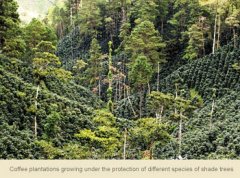
Guatemala Coffee planting Environment Guatemala Coffee cultivation
Faced with severe landscape changes and shrinking habitats, more than 90 species of migratory birds have found refuge in shaded trees. In early autumn (north temperate zone), birds such as Nashville warbler (Vermivoraruficapilla), wide-winged eagle (Buteo swordfish), crested flycatcher (Myiarchuscrinitus), lovely summer Donna Finch (Piranga bayberry), Raptors and others frequently shadow coffee.